
A Complete Guide to Enjoy the Sun Without Regret
Summer brings warm days, beach trips, and that irresistible glow. Yet safe sunbathing balances pleasure with protection. You can enjoy golden hours outdoors while keeping your skin healthy for years to come. This guide shares practical, up-to-date advice based on dermatologist recommendations and health organizations.
Introduction: Why Safe Sunbathing Matters
Picture yourself relaxed on a sunny beach. Waves crash gently. A light breeze touches your skin. This feels like pure joy. But behind the beauty hides a serious risk. Ultraviolet rays from the sun can damage your skin deeply.
In 2026, doctors expect about 112,000 new invasive melanoma cases in the United States alone. Of those, around 65,400 will affect men and 46,600 women. Melanoma ranks as the fourth most common cancer in men and fifth in women. An estimated 8,510 people will lose their lives to it this year.
These numbers rise steadily. Skin cancer, including melanoma, affects millions worldwide. The good news? Most cases link to preventable UV exposure. You hold the power to protect yourself and your family.
Safe sunbathing does not mean hiding indoors. It means smart choices that let you savor summer while lowering risks. Ready to learn how?
Read also:
Why tanning isn’t always a good thing: risks and myths
Benefits and Harms of the Sun
Sunlight lifts your mood and boosts energy. It helps your body make vitamin D, which supports strong bones, immune function, and overall wellness. Short, sensible exposure delivers these perks.
Yet the sun also brings harm. UV rays divide into UVA and UVB. UVA rays penetrate deeply. They cause premature aging, wrinkles, and dark spots. UVB rays burn the surface and play a bigger role in skin cancer.
Read also:
SPF, PPD, PA, UVA, UVB – What do all these letters really mean?
Long-term damage adds up. Repeated exposure leads to photoaging — leathery skin, sunspots, and loss of elasticity. More seriously, it raises melanoma and other skin cancer risks. No such thing as a “healthy tan” exists. Any color change signals DNA damage in your skin cells.
Balance is key. Experts from the American Academy of Dermatology (AAD) recommend getting vitamin D from food and supplements rather than unprotected sun time. You can enjoy benefits safely with the right habits.
Discover Your Skin Phototype (With a Simple Test)
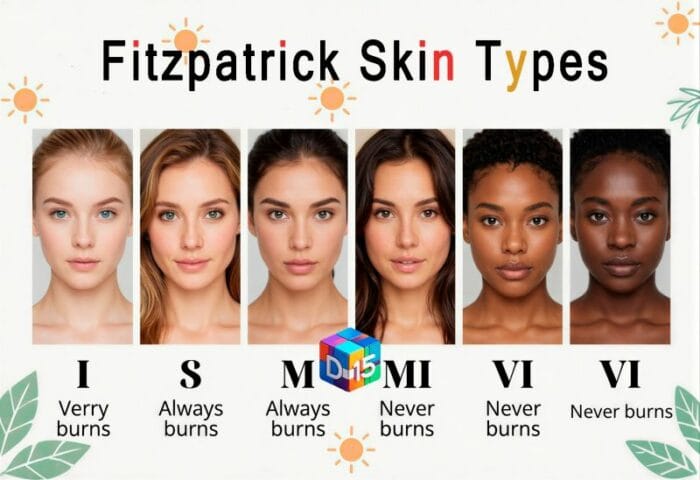
Not all skin reacts the same to sun. The Fitzpatrick scale helps you understand your type. It ranges from I (very fair) to VI (deeply pigmented). Knowing yours guides safe exposure times and protection needs.
Quick Self-Test Answer these questions and add up your score (0–4 points each):
- Eye color? Light blue/gray/green (0), blue/green (1), hazel (2), brown (3), dark brown/black (4)
- Natural hair color? Red/blonde (0-1), light brown (2), dark brown (3), black (4)
- Unexposed skin color? Very pale/white (0), fair (1), light beige (2), olive/brown (3), dark brown/black (4)
- Freckles on unexposed areas? Many (0), some (1), few (2), none (3-4)
- How does your skin react to first summer sun? Always burns, never tans (0), burns easily (1), burns moderately (2), burns rarely (3), never burns (4)
- How well do you tan? Never (0), lightly (1), moderately (2), deeply (3), very dark (4)
Total score interpretation:
- 0–7: Type I – Extremely fair, always burns
- 8–16: Type II – Fair, usually burns
- 17–25: Type III – Light, sometimes burns
- 26–30: Type IV – Moderate brown, rarely burns
- 30+: Type V–VI – Dark, very rarely burns
Examples in action: A Type I person might burn in just 10 minutes without protection. A Type IV can stay out longer but still needs sunscreen to prevent long-term damage. Use your type to personalize your sun plan.
| UV Index | Risk Level | What This Means |
|---|---|---|
| 0-2 | Low | Safe for most people. Minimal protection needed. |
| 3-5 | Moderate | Wear sunscreen. Limit time in direct sun. |
| 6-7 | High | Extra protection required. Seek shade during peak hours. |
| 8-10 | Very High | Avoid midday sun. Full protective measures essential. |
| 11+ | Extreme | Stay indoors if possible. Serious burn risk in minutes. |
Golden 7 Rules of Safe Sunbathing
Follow these simple rules for maximum enjoyment and minimum risk.
- Check the UV Index daily. Stay in shade when it hits 3 or higher, especially midday.
- Seek shade smartly. Use umbrellas, trees, or canopies between 10 AM and 4 PM.
- Cover up. Wear UPF clothing, wide-brimmed hats, and sunglasses.
- Apply broad-spectrum sunscreen correctly (more on this soon).
- Reapply often — every two hours, or after swimming/sweating.
- Hydrate inside and out. Drink water and moisturize skin.
- Listen to your skin. If it feels hot or turns pink, get out of the sun immediately.
These rules work together like a strong team. Miss one, and protection weakens.
Choosing and Applying Sunscreen the Right Way
What to look for in 2026: Choose broad-spectrum (UVA + UVB), SPF 30 or higher, and water-resistant formulas. Mineral sunscreens with zinc oxide or titanium dioxide suit sensitive skin. Chemical filters work well for others.
Comparative Table: Mineral vs Chemical Sunscreen
| Feature | Mineral Sunscreen | Chemical Sunscreen |
|---|---|---|
| How it works | Reflects UV rays | Absorbs UV rays |
| Skin feel | Can feel thicker | Usually lighter, invisible |
| Best for | Sensitive, acne-prone skin | Everyday use, makeup base |
| White cast | Possible on darker tones | None |
| Reef safety | Generally better | Check labels for ocean-friendly |
Application tips (do this right): Use about one ounce (shot glass full) for your body. Apply a teaspoon to your face. Spread 15–20 minutes before going outside. Cover often-missed spots: ears, neck, tops of feet, and lips. Reapply generously.
Pro example: On a beach day, apply before leaving home. Reapply after every swim. Set a phone timer so you never forget.
Your Ideal Beach Day Schedule

Plan your day around the sun for safe fun.
- Morning (before 10 AM): Enjoy peak safe hours. Swim, walk, play games.
- Midday (10 AM – 4 PM): Stay under shade. Read, eat, nap, or visit indoor spots.
- Late afternoon (after 4 PM): Sun softens. Resume activities with continued protection.
Sample 8-hour beach day: 8:00 AM – Arrive, apply sunscreen. 9:00–10:30 AM – Active fun in sun. 10:30 AM–2:00 PM – Shade time with lunch and rest. 2:00–3:30 PM – Gentle afternoon activities. 3:30 PM onward – Reapply and enjoy golden hour.
Adjust for your phototype and location. Hotter climates need stricter shade rules.
After Sun Care: Soothe and Repair
Your skin needs love after exposure. Cool showers help. Aloe vera or gentle moisturizers calm redness. Avoid hot water and harsh scrubs.
Drink plenty of water. Eat antioxidant-rich foods like berries, greens, and nuts. They fight free radicals from UV exposure.
Watch for burns. If skin turns red and painful, treat it like a wound. Seek medical help for severe blisters or fever.
Special Cases: Children, Pregnant Women, and the Elderly
Children: Babies under 6 months stay out of direct sun. Use shade, hats, and clothing. For older kids, choose kid-friendly SPF 30+ formulas. Teach them good habits early.
Pregnant women: Hormones make skin more sensitive. Use mineral sunscreens. Stay hydrated. Consult your doctor about vitamin D needs.
Elderly: Thinner skin and medications increase sensitivity. Extra protection prevents easy burns and spots. Regular skin checks matter more with age.
Common Myths and Misconceptions of Sunbathing
Myth 1: A base tan protects you. Reality: It equals only SPF 3–4. Not worth the damage.
Myth 2: Indoor tanning is safer. Reality: Tanning beds deliver intense UVA. They raise melanoma risk significantly.
Myth 3: Sunscreen blocks all vitamin D. Reality: You still make some, and diet/supplements cover needs safely.
Myth 4: Dark skin needs no protection. Reality: Everyone benefits from sunscreen. Darker tones can still get cancer and photoaging.
Myth 5: Cloudy days are safe. Reality: Up to 80% of UV rays penetrate clouds.
Conclusion: Embrace Smart Sun Enjoyment
Safe sunbathing lets you create beautiful summer memories without future regret. Protect your skin today for glowing, healthy skin tomorrow. Small daily choices add up to big results.
Beach Day Checklist
- Check UV index
- Broad-spectrum SPF 30+ sunscreen
- Wide-brimmed hat and UPF clothing
- UV sunglasses
- Lip balm with SPF
- Umbrella or shade tent
- Water bottle and snacks
- After-sun aloe/moisturizer
- Phone timer for reapplication
- Skin self-check routine
Print this list and keep it in your beach bag.