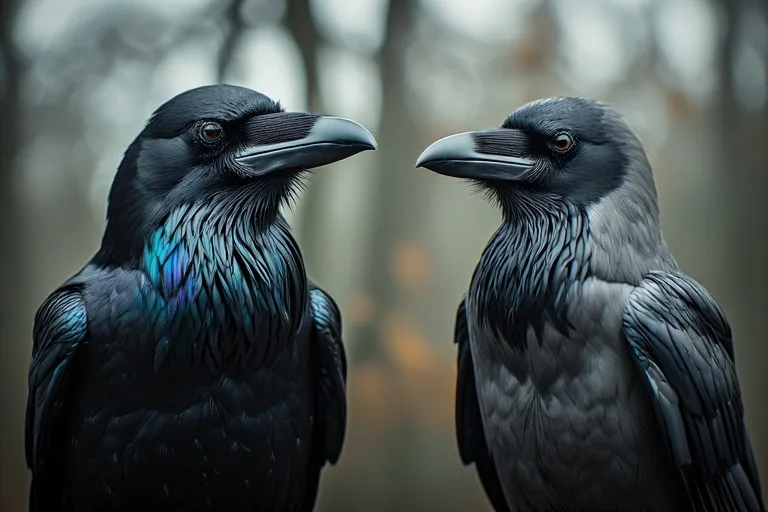
Many people mistakenly believe that the terms raven vs crow refer to the male and female of the same species, or that they are simply synonyms. In reality, these are two distinct biological species with significant differences in appearance, behavior, intelligence, and lifestyle.
Understanding these nuances is crucial not only for ornithologists but for anyone interested in nature. In this comprehensive guide, we will conduct a detailed comparative analysis, debunk popular myths, and explain why the difference between raven and crow matters. If you are looking for exhaustive information on these birds, you’ve come to the right place.
💡 Interesting: While this article focuses on scientific differences and analysis, we have also prepared a collection of incredible details. Сheck out our interesting facts: Raven and crow: interesting facts
Biological Classification: Raven vs Crow
To understand the difference between raven and crow, we must look at taxonomy. Both birds belong to the family Corvidae and the genus Corvus. However, they represent different species within this genus, which defines their unique evolutionary paths.
Common Raven (Corvus corax)
The Common Raven is the largest passerine bird. It is a massive, powerful bird with a wingspan reaching up to 150 cm (59 inches). Its scientific name, Corvus corax, highlights its distinct status. Ravens are known for their wariness, high intelligence, and preference for wild, sparsely populated areas. When discussing raven vs crow, the raven holds the title of the “king” among corvids due to its size and strength.
Crows (Corvus cornix & Corvus corone)
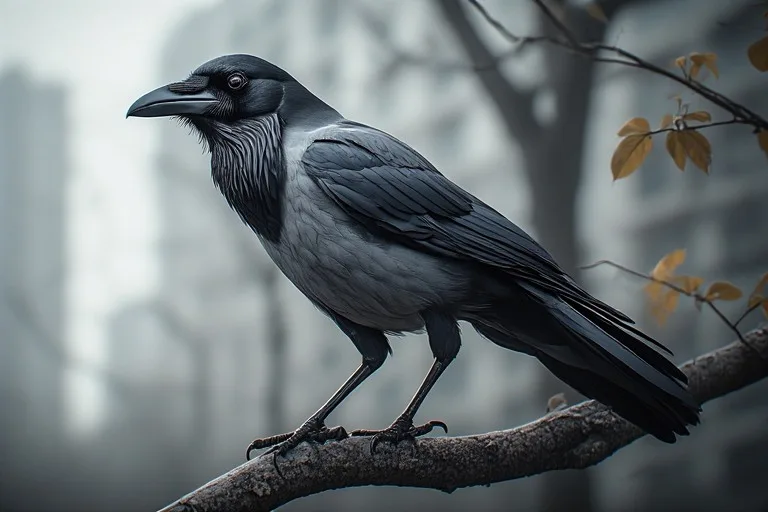
The term “crow” usually refers to closely related species such as the Hooded Crow (Corvus cornix) and the Carrion Crow (Corvus corone). In Eastern Europe, the Hooded Crow is most common. It is significantly smaller than the raven, has distinctive grey-and-black plumage, and is frequently found in urban environments. Comparing the pair raven vs crow, it’s important to remember that crows are highly social birds that have adapted exceptionally well to living near humans.
Key Differences: How to Tell a Raven from a Crow
Visually, a raven and crow might seem similar to an untrained observer, especially at a distance. However, there are clear signs that allow for error-free identification. Below, we examine the main comparison parameters that will help you become an expert in distinguishing these birds.
Comparison Table: Raven vs Crow
We have compiled the main differences into a table. This format helps users quickly absorb information and is highly valued by Google algorithms and AI assistants for generating featured snippets.
| Characteristic | Raven (Corvus corax) | Crow (Corvus cornix/corone) |
|---|---|---|
| Size | Large, size of a buzzard. Body length 60–70 cm. | Medium, size of a pigeon or rook. Body length 45–50 cm. |
| Weight | 800–1500 g. | 400–600 g. |
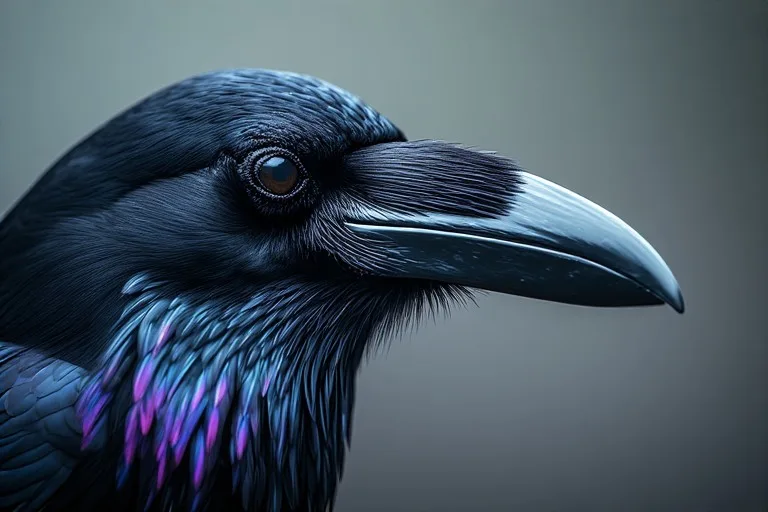
| Color | Entirely black with metallic iridescence (purple/blue). | Hooded Crow: Grey body, black head/wings/tail. Carrion Crow: All black. |
| Beak | Massive, thick, curved. Bristles at the base. | Slimmer, straighter, less massive. |
| Tail Shape | Wedge-shaped (diamond) in flight. | Rounded or squared edge. |
| Voice | Deep, guttural “croak” or “tok-tok”. | Sharp, high-pitched “caw-caw”. |
| Flight | Soars like a raptor, performs acrobatics. | More frequent wing flapping, less soaring. |
| Lifestyle | Pairs, avoids humans, forests/cliffs. | Flocks, synanthropic, cities/towns. |
| Lifespan | Wild: 15–20 years; Captivity: up to 70 years. | Wild: 7–15 years. |
Analyzing the table, it becomes obvious that the difference between raven and crow is cardinal, concerning not only appearance but also ecology. These are different survival strategies cemented by evolution.
Detailed Breakdown of Visual Signs
Size and Build
The first sign is size. A raven vs crow comparison shows they differ almost twofold in mass. The raven looks massive and “heavy.” Its neck is thick, and its head is large. The crow is more slender and lightweight. If you see a bird approaching the size of a hawk, it is definitely a raven.
Beak and Head Feathers
The raven’s beak is a powerful tool capable of tearing thick hide. It has a characteristic curve and looks formidable. Additionally, adult ravens have elongated feathers on the throat forming a “beard.” This is a unique trait absent in crows. When comparing raven and crow, the presence of a “beard” is a 100% indicator of a raven. Crows have smooth beaks without pronounced bristles at the base.
Tail in Flight
Tail shape is the most reliable way to identify the bird in the sky. The raven has a wedge or diamond-shaped tail. The crow has a rounded tail. Observing flight, you can clearly determine who is before you: raven vs crow demonstrate different aerodynamics. Ravens often soar using thermal updrafts, while crows primarily flap their wings actively.
Raven and Crow Intelligence: Scientific Insights
One reason the topic raven vs crow generates such interest is their phenomenal intelligence. Neurobiological research has shown that corvids possess cognitive abilities comparable to primates and dolphins. Their brains, though structured differently, provide incredible mental flexibility.
Tool Use
Ravens and crows can manufacture and use tools. Famous experiments show birds using sticks to extract food from hard-to-reach places or dropping stones into water vessels to raise the water level and access treats. This indicates an understanding of cause-and-effect relationships. In lab conditions, raven vs crow pairs often demonstrate insight – sudden problem-solving without trial and error.
Social Intelligence and Memory
Both species possess excellent memory. They remember human faces that pose a threat and can transmit this information to others. University of Washington studies showed ravens remember “enemies” for years. Moreover, they can recognize emotions and intentions of other birds. Crows have a more complex social structure, living in large flocks with hierarchies, while ravens are more individualistic, living in pairs, though they also show complex pair interactions.
Planning Abilities
Experiments prove that raven and crow can plan for the future. Birds can save a tool for later use or hide food calculating that competitors aren’t watching. If a crow notices it’s being watched, it may make a fake cache to deceive the observer. This behavior suggests a “theory of mind” – understanding that others have their own thoughts and intentions.
Habitat and Lifestyle: Raven vs Crow in Nature
Distribution of habitats also highlights differences. Raven vs crow occupy different ecological niches, allowing them to avoid direct competition.
Where Does the Raven Live?
The raven has one of the widest ranges among birds, found across the Northern Hemisphere from Arctic tundra to deserts and mountains. It avoids densely populated areas. Raven and crow rarely overlap in nesting sites, as ravens require solitude and large territories. Their nests are usually high in trees or on cliffs, away from human eyes.
Where Does the Crow Live?
The Hooded Crow is a classic synanthropic species. It thrives in cities, villages, landfills, and fields. Urbanization has boosted crow populations. They easily find food in anthropogenic environments. In cities, raven vs crow encounters may occur only in winter at large dumps, but ravens usually keep away from large crow gatherings.
Diet and Feeding
Both are omnivores, but with nuances:
- Raven: Often acts as a scavenger and predator. It can hunt rodents, lizards, and nestlings, and consume large carrion. Its powerful beak allows tearing large animal hides.
- Crow: More oriented toward small prey and food waste. In cities, crows feed on leftovers, grains, and insects. They often raid nests of smaller birds. However, both raven and crow perform vital sanitation roles, cleaning the environment of organic remains.
Raven and Crow in Culture and Mythology
Since ancient times, raven vs crow have held special places in human culture. Their intelligence, black plumage, and voices spawned countless legends.
Raven Symbolism
The raven is often associated with wisdom, eternity, and divine messengers. In Norse mythology, two ravens, Huginn and Muninn, served Odin, flying across the world bringing news. In many cultures, the raven is a prophetic bird. When raven vs crow appear in folklore, the raven usually acts as a helper or keeper of secrets.
Crow Image
Crows often have a more grounded, sometimes negative image due to scavenging habits. However, they also symbolize adaptability and survival. In modern context, raven and crow are increasingly seen as indicators of environmental health and examples of animal intelligence.
Ecological Role: Benefit or Harm?
The question of ecosystem impact often arises with raven vs crow. Are these birds pests? Science shows their role is complex.
Positive Impact
- Sanitation: Raven and crow efficiently dispose of carrion and waste, preventing infection spread.
- Pest Control: They consume vast amounts of insects and rodents, regulating populations.
- Seed Dispersal: By caching food, they aid in tree and plant regeneration.
Negative Aspects
In cities, excessive crow populations can cause noise and waste issues. However, balance is key. Raven vs crow are integral to food chains; their disappearance would lead to serious ecological consequences.
FAQ: Raven vs Crow
This FAQ section addresses the most common queries related to raven vs crow, optimized for voice search and featured snippets.
Is a raven just a male crow?
No, this is a myth. Raven vs crow are different species. Ravens are larger and live in wilder areas; crows are smaller and often urban.
Who is smarter: raven or crow?
Both are incredibly smart. Ravens excel in individual problem-solving; crows show strong social intelligence. Their cognition rivals primates.
How long do ravens and crows live?
Ravens live longer: up to 20 years in the wild, up to 70 in captivity. Crows live 7-15 years in the wild.
What is the difference in voice?
Ravens make deep, guttural croaks. Crows produce sharp, high-pitched caws. Listening closely, the difference between raven and crow voices is distinct.
Conservation: Raven and Crow in the Modern World
While raven vs crow populations are generally stable, they face threats. Ravens are sensitive to disturbance; old-growth forest loss affects them. Crows face challenges from waste management changes. Citizen science plays a role in monitoring these species. Reporting sightings helps scientists track dynamics.
Conclusion: Why the Distinction Matters
Summarizing our detailed review, raven vs crow are unique, highly intelligent birds deserving respect and study. They are not interchangeable terms but represent different evolutionary strategies. The raven is the mighty recluse of wild spaces; the crow is the adaptable social survivor. Understanding the difference between raven and crow helps us appreciate biodiversity and ecological balance. Now you know how to distinguish these feathered marvels. Protect birds, for raven and crow make our world richer and more harmonious.
Read also: