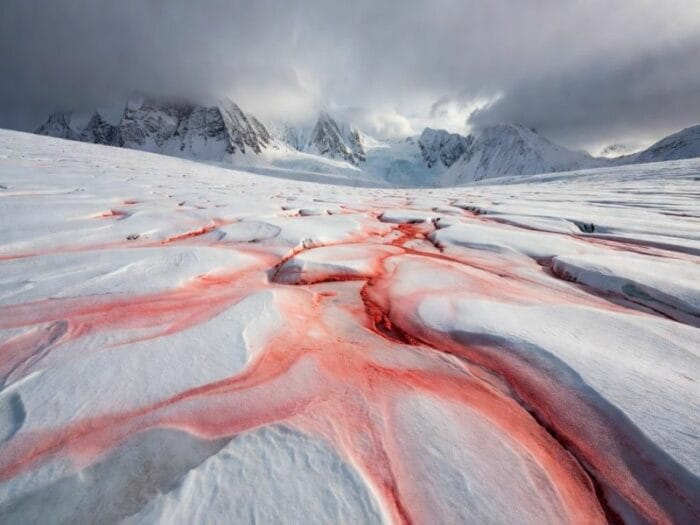
From Antarctic glaciers to Alpine peaks, blood snow is both a breathtaking natural wonder and a worrying sign of climate change.
Introduction
When a bright flash streaks across the night sky and snow turns blood-red, it evokes both fear and fascination. The term blood snow refers to an unusual natural phenomenon in which snow takes on a reddish or pinkish hue – ranging from faint rose to vivid crimson. First documented by Aristotle over 2,300 years ago, blood snow is not a myth or a supernatural omen: it has a well-understood scientific basis with profound implications for our changing climate.
Read also: Colored snow
In this comprehensive guide, we will explore how and why blood snow occurs, the key factors that influence it, where in the world you can witness it, and most critically what it signals about the health of our planet.
What Is Blood Snow?
Blood snow – also widely known as watermelon snow, pink snow, red snow, or glacial blood is snow that exhibits a reddish coloration. This discoloration arises from the presence of pigmented particles embedded within the snowpack. In the vast majority of cases, the color comes from blooms of cryophilic (cold-loving) green algae that produce a protective red carotenoid pigment. In other cases, airborne dust, volcanic ash, or industrial pollutants are responsible.
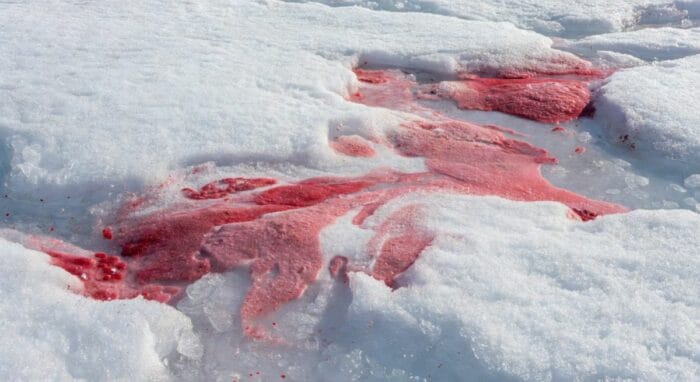
Visually, blood snow can appear in patches scattered red spots on an otherwise white surfaceor as sweeping streaks across entire glacier fields. Depending on the concentration and type of particles, the shade ranges from light pink to deep burgundy. A telltale sign of genuine algae-based blood snow is its subtle, sweet scent, often compared to watermelon hence the nickname.
A close-up view of watermelon snow algae blooming on a melting glacier surface. The red pigment is astaxanthin, a carotenoid.
Scientific Causes of Red Snow
Scientists classify blood snow causes into two broad categories: biological (algae blooms) and abiological (mineral dust, volcanic ash, and anthropogenic pollutants). The table below summarizes the most common sources and their characteristic coloration:
| Source | Particle Type | Coloration Characteristics |
|---|---|---|
| Saharan Dust | Sand, clay, mineral particles | Light pink to pale orange |
| Volcanic Ash | Rock fragments, minerals | Deep red, nearly burgundy |
| Algae Blooms | Chlamydomonas nivalis / Sanguina nivaloides | Bright red to watermelon pink |
| Industrial & Aerospace | Metals, chemical compounds | Bright red, occasionally purplish |
Table 1: Major sources of red coloration in snow and their visual characteristics.
Understanding which cause is at play in a given event is critical, because the implications ecological, climatic, and health-related differ significantly.
Algae Blooms: The Primary Culprit
The single most common cause of blood snow is the proliferation of Chlamydomonas nivalis, a species of green algae. Recent taxonomic research (2020) has reclassified the dominant red-snow organism into a new genus: Sanguina nivaloides (producing red snow) and Sanguina aurantia (producing orange snow). Despite the name change, the underlying biology remains the same.
These are cryophilic algae they thrive in freezing water. During winter, they lie dormant within the snowpack. When summer arrives and temperatures rise, liquid water becomes available on the snow surface, and the algae bloom explosively. A single teaspoon of melted watermelon snow can contain over one million algal cells.
Key Mechanism: Carotenoid Pigments
Although the algae are green (they contain chlorophyll for photosynthesis), they produce a bright red carotenoid pigment called astaxanthin. This pigment serves a dual purpose: it acts as a natural sunscreen, protecting the chloroplast from intense visible and ultraviolet radiation, and it absorbs heat, which keeps the surrounding snow melting providing the liquid water the algae need to survive. The same pigment gives salmon flesh, shrimp, and flamingo feathers their pink color.
Atmospheric Dust & Other Causes
While algae dominate the headlines, a significant portion of blood snow events are driven by atmospheric dust transport. Saharan dust storms lift millions of tons of fine sand and mineral particles into the upper troposphere, where atmospheric rivers carry them thousands of kilometers all the way to the European Alps, Scandinavia, and even North America.
When this dust-laden air encounters precipitation, the particles are washed out and deposited onto snow surfaces, producing what is sometimes called “blood rain” or “red snow”. A 2021 study by Khalifa University demonstrated a direct link between atmospheric rivers and extreme Saharan dust transport events toward Europe and projected that these events will become more frequent under global warming.
Other Abiological Sources
Volcanic eruptions eject ash and mineral fragments into the atmosphere that can settle on snow, producing dark red or burgundy discoloration. Industrial pollution and aerospace debris (metals, chemical compounds) can also contribute to red snow in localized areas, though these are far less common.Wildfire ash from large-scale forest fires can similarly tint snow pink or red when carried by wind currents.
Where Can You Observe Blood Snow?
Blood snow occurs on every continent with permanent or seasonal snow cover. However, some locations are particularly well-known for regular, dramatic displays:
- Antarctica – Vernadsky Research Base – The most famous modern sightings. Ukrainian researchers documented dramatic red streaks across glaciers near Galindez Island during the austral summer.
- Sierra Nevada, California – At altitudes of 10,000 – 12,000 feet (3,000 – 3,600 m), watermelon snow appears regularly during the summer melt season. Hikers often report pink boot-prints on trails.
- The European Alps – Saharan dust transported by atmospheric rivers settles on Alpine snow, triggering microalgae growth that turns pistes pink and orange. Events are becoming more frequent.
- Greenland Ice Sheet – Research teams (including the ALPALGA project) study darkening ice caused by snow algae blooms across vast sections of the Greenland ice sheet during summer.
- Svalbard & Iceland – Arctic field studies have documented algal blooms covering up to 50% of snow surfaces by the end of the melt season in these northerly locations.
The best time to observe blood snow is during the summer melt season (typically June – August in the Northern Hemisphere, December – February in the Southern Hemisphere), when liquid water availability triggers algae blooms and dust deposition events are most frequent.
Climate Impact: The Albedo Feedback Loop
Blood snow is more than a visual curiosity – it is a measurable climate feedback mechanism. The red pigment darkens the snow surface, reducing its albedo (reflectivity). Pure white snow reflects up to 90% of incoming solar radiation; red snow can reflect as little as 50 – 60%. The absorbed heat accelerates melting, which in turn provides more liquid water for further algae growth. This creates a dangerous positive feedback loop:
- 🔴 Darker snow absorbs more heat
- 💧 More melting = more liquid water
- 🦠 More water = more algae blooms
- 🔴 More algae = even darker snow
- ⚠️ Accelerated glacial melting
A landmark study published in Nature Communications (2016) and follow-up research in Science Advances (2023) found that snow algae cover up to 5% of glaciers in northwestern North America, with coverage reaching 65% in some areas by the end of the melt season. The ALPALGA project a multi-disciplinary effort bringing together biologists, ecologists, and glaciologists continues to study how algal proliferation affects melting rates across the world’s ice sheets.
Albedo Effect by the Numbers
Clean snow albedo: ~0.80–0.90 (80–90% reflection). Red snow albedo: ~0.50–0.65. A drop of 0.1 in albedo can increase absorbed solar energy by 10–15 W/m², dramatically accelerating melt rates. Researchers warn that as global temperatures rise, the frequency and intensity of blood snow events will increase creating an ever-stronger feedback loop that amplifies glacial retreat and sea-level rise.
Health Risks & Safety Precautions
While blood snow itself is not acutely toxic, the particles responsible for the coloration can pose health risks, particularly for individuals with pre-existing respiratory or dermatological conditions.
Respiratory Concerns
Inhaling fine particulate matter (PM2.5 and PM10) from Saharan dust or volcanic ash can trigger asthma attacks, bronchitis, and other respiratory issues. Algae-based blood snow may release aerosolized organic compounds during melting.
Skin & Eye Irritation
Direct skin contact with algae-laden snow can cause irritation, rashes, and allergic reactions in sensitive individuals. Eye contact may result in conjunctivitis. Always rinse thoroughly after accidental exposure.
Historical Records & Cultural Significance
Blood snow has captured the human imagination for millennia. Aristotle documented the phenomenon in the 4th century, making it one of the earliest recorded natural history observations. In the 19th century, British explorer John Ross reported red snow during his 1818 Arctic expedition, and botanist Robert Brown published the first scientific description attributing the color to an algal organism.
In modern popular culture, blood snow frequently appears in films, literature, and television as a dramatic visual motif. Movies like Dead Snow use crimson-stained snow to evoke horror and dread. In science fiction, red snow often symbolizes environmental catastrophe or alien ecosystems a metaphor that resonates ever more strongly as real-world climate change makes the phenomenon increasingly common.
The Scottish Highlands recorded blood snow events in the 19th century, and scientific documentation from the Cairngorm Mountains followed in 1967. Today, with satellite imagery and widespread scientific monitoring, we can track blood snow events globally in near-real time transforming what was once a rare curiosity into a vital data point for climate science.
Conclusion
Blood snow is far more than a striking visual curiosity. It is a visible, measurable symptom of a changing planet. Whether caused by algal blooms thriving in warmer temperatures or by dust storms intensified by desertification, the crimson stain on our glaciers tells an urgent story about the interconnectedness of Earth’s systems.
Every change in the ecosystem can lead to unpredictable consequences and blood snow is a powerful reminder that we are part of this complex system. Understanding the causes and implications of red snow is a decisive step toward protecting both ourselves and the natural world from the mounting threats of climate change.
Stay informed. Stay safe. And never stop being curious about the world around you.
More on the topic: Earth’s magnetic field: The invisible shield of our planet