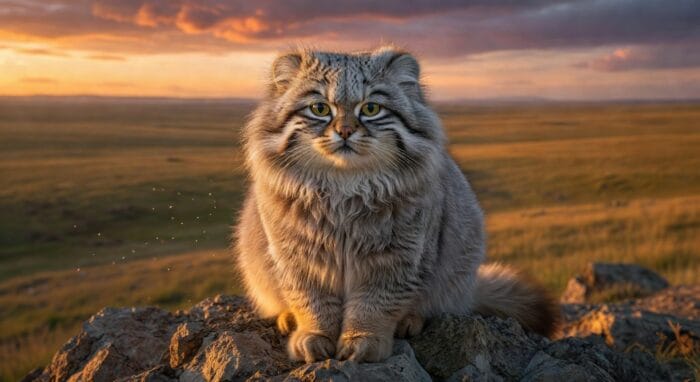
The Pallas’s cat, also known as the manul (Otocolobus manul), is one of the most enigmatic and captivating wild cats on our planet. This small predator has won the hearts of millions of people across social media thanks to its unmistakable appearance: extraordinarily fluffy fur, a flat round face, and a permanently grumpy expression. The Pallas’s cat belongs to the family Felidae and is classified among the small cats, yet its unique features make it completely unlike any other feline in the world. In this comprehensive guide, we will explore everything known about this remarkable animal – from its ancient origins and distinctive appearance to its solitary character, hunting strategies, natural habitat, and conservation status.
The ancient origins of the Pallas’s cat: a contemporary of the saber-toothed tiger
As a distinct species within the cat family, the Pallas’s cat first appeared on Earth approximately 10-12 million years ago, making it one of the oldest surviving members of the Felidae family. According to paleontological estimates, this animal was a contemporary of the legendary saber-toothed tiger. However, unlike its mighty counterpart, the manul managed to survive and adapt to the ever-changing environmental conditions throughout millions of years of evolution.
The secret behind this small wild cat’s survival lies in its exceptional camouflage abilities, modest dietary requirements, and remarkable capacity to withstand extremely low temperatures. While large predators vanished due to climate change and the disappearance of large prey, the Pallas’s cat continued to thrive in the harsh steppes and mountains of Central Asia.
For a long time, there was a popular theory that fluffy manuls were the ancestors of modern Persian cats. This hypothesis arose due to the superficial resemblance between the two: both possess long dense fur and a characteristically flat face. However, modern genetic research has definitively debunked this assumption – the Pallas’s cat is an entirely separate species with no direct ancestral connection to domestic Persian cats.
Where does the name “Pallas’s cat” come from and who discovered it?
The word “manul” has Turkic roots and translates as “swift,” which is rather ironic considering that this animal is considered one of the slowest members of the cat family. The name likely refers to the short but lightning-fast lunges the manul executes during ambush hunting.
This wild cat also bears the alternative name Pallas’s cat, given in honor of the distinguished German naturalist Peter Simon Pallas, who was the first scientist to formally describe the species in 1776. Pallas discovered the unusual cat on the shores of the Caspian Sea during a major scientific expedition across the Russian Empire and assigned it the Latin name Otocolobus manul.
This Latin binomial has a rather amusing translation – “ugly ear.” The name is explained by the manul’s characteristic sideburns (cheek ruffs), which are so thick and expansive that they almost completely conceal its small rounded ears. This distinctive feature has made the animal instantly recognizable among other wild cats.
The nickname “the eternally displeased wild cat” was bestowed upon the Pallas’s cat because of its flattened face, which creates an impression of constant dissatisfaction. This facial expression has become the animal’s true calling card on the internet and has made the manul one of the most “meme-worthy” animals in the world.
Physical appearance of the Pallas’s cat: the fluffiest feline on Earth
Fur and body dimensions
The Pallas’s cat possesses a stocky, compact body and extraordinarily long, dense fur that is considered the fluffiest and thickest among all members of the cat family. This remarkable feature is the result of evolutionary adaptation to the extremely cold climate of Central Asia.
The numbers are truly staggering: on the manul’s back, a single square centimeter of skin supports up to 9,000 individual hairs. The length of each individual hair can reach 7 centimeters (approximately 2.75 inches). Thanks to this phenomenal fur density, the Pallas’s cat appears to be significantly larger than an ordinary domestic cat. However, this is merely an optical illusion.
The animal’s actual dimensions are quite modest:
- Head-and-body length: 46 to 65 cm (18 to 26 inches)
- Tail length: 21 to 35 cm (8 to 14 inches)
- Weight: 2 to 5 kg (4.4 to 11 lbs)
These measurements are comparable to those of an average domestic cat. The difference lies entirely in the fur, which visually doubles the animal’s apparent size.
Distinctive physical features
Beyond its dense fur, the Pallas’s cat has a number of unique external characteristics that set it apart from other wild felines:
- A flat, rounded face with widely spaced eyes, giving the animal its signature suspicious or displeased expression.
- Small, rounded ears positioned quite low on the head and almost entirely hidden by luxuriant sideburns (cheek ruffs).
- Round pupils, unlike the vertical slit pupils of most small cats. This trait makes the manul’s eyes extremely expressive and gives it a somewhat “owl-like” appearance.
- Short, powerful legs adapted for traversing uneven, rocky terrain.
- A thick, fluffy tail with a black tip and several dark rings. Interestingly, in cold weather, Pallas’s cats have a habit of placing their front paws on their bushy tails to warm their paw pads – this behavior has become one of the most photographed moments on social media.
- Powerful canine teeth that are nearly three times longer than those of a domestic cat, attesting to this animal’s predatory nature.
Three subspecies of the Pallas’s cat: geographic distribution
Three main subspecies of the Pallas’s cat are recognized worldwide, differing primarily in fur coloration and geographic range. Each subspecies is adapted to the specific conditions of its region.
1. The nominal (Siberian) Pallas’s cat
This subspecies inhabits Siberia, the Altai Mountains, Mongolia, and China. Its distinguishing feature is a predominantly light grey coloration that helps it blend in among rocky steppes and semi-deserts. The Siberian subspecies is the most thoroughly studied, thanks to decades of research by Mongolian and Russian zoologists.
2. The Central Asian Pallas’s cat
This subspecies is most commonly found in Afghanistan, Uzbekistan, Pakistan, Turkmenistan, Tajikistan, Iran, and Kazakhstan. Its key distinguishing feature is a more reddish coat with reddish stripes, providing effective camouflage among the sandy and clay landscapes of Central Asia.
3. The Tibetan Pallas’s cat
This subspecies inhabits Tibet, Kashmir, and Nepal – the highest-altitude portions of the species’ range. Its fur is darker than that of other subspecies, but in winter it acquires a silvery sheen that helps the animal blend seamlessly into the snowy landscape of high-altitude plateaus.
Pallas’s cat habitat: from steppes to mountain peaks
Encountering a Pallas’s cat in the wild is an extraordinarily difficult task, even for experienced naturalists. These animals lead a primarily nocturnal and crepuscular lifestyle: they hunt at night or in the early morning, while spending daylight hours hidden in shelters – rocky crevices, cavities beneath boulders, and abandoned burrows of marmots and foxes.
Landscape preferences
The Pallas’s cat inhabits a variety of landscapes – from flat steppes and semi-deserts to high-altitude plateaus. Height does not intimidate this wild feline: it is capable of ascending to elevations of up to 5,500 meters (18,000 feet) above sea level. The primary requirement for a habitat is the presence of nearby shrubs, rocky outcrops, or slopes that provide concealment from predators. Open terrain without cover is strictly avoided.
Resilience to extreme temperatures
The Pallas’s cat has no fear of freezing temperatures whatsoever. In its native habitat, temperatures can plunge to -50°C (-58°F), and the animal’s dense fur provides reliable insulation against even the most brutal cold. However, there is one significant limitation: moving through deep, loose snow is extremely difficult for the animal due to its short legs. Therefore, the manul selects areas where snow depth does not exceed 20 centimeters (8 inches).
Interestingly, despite its impressive cold tolerance, the Pallas’s cat copes very poorly with high temperatures. Its extraordinarily dense fur, which is a lifesaver in freezing conditions, becomes a genuine ordeal in warm environments. This is one of the key reasons why keeping a Pallas’s cat in domestic settings is not only illegal in most countries but also dangerous to the animal’s health.
Pallas’s cat diet: What the Slowest cat in the World Eats
Primary diet
More than half of the Pallas’s cat’s diet consists of small rodents and pikas (lagomorphs). Additionally, it preys on hamsters, squirrels, and less frequently on ground squirrels, hares, hedgehogs, and small birds. During summer months, the manul may also feed on insects, particularly beetles and grasshoppers, supplementing its diet with additional protein.
Hunting tactics
This dietary preference is explained by the manul’s physiological characteristics. The animal is incapable of pursuing prey over long distances. According to zoologists, the Pallas’s cat is considered the slowest predator among all felines. Its short stature and stocky body are simply not built for sustained running.
Instead of chasing prey, the manul employs ambush tactics. It patiently waits near a rodent’s burrow or among rocks, remaining absolutely motionless, and strikes with lightning speed when prey approaches within pouncing distance. The camouflage coloration of its fur allows it to remain virtually invisible even among low-growing vegetation.
Thanks to this sophisticated hunting strategy, the Pallas’s cat is regarded as an intelligent and resourceful animal. It compensates for its lack of speed with patience, keen observation, and a masterful ability to blend into its surroundings.
Pallas’s cat behavior and temperament: a solitary cat loyal to its territory
Territorial behavior
The Pallas’s cat is a quintessential solitary cat that leads an exclusively solitary lifestyle and jealously guards its territory. Notably, its “home” is far from small:
- Female territory size: 7.4 to 125 km² (2.9 to 48 sq mi)
- Male territory size: 21 to 207 km² (8 to 80 sq mi)
On average, across an area of 100 km² (39 sq mi), only 4 individual manuls reside. This remarkably low population density is explained by the animal’s solitary nature and its need for extensive hunting grounds.
Each individual meticulously marks the boundaries of its territory with scent markers and actively avoids contact with other manuls. This extreme reclusiveness is one of the primary reasons why studying this species in its natural habitat remains an exceptionally challenging endeavor for researchers.
Communication
Pallas’s cats very rarely vocalize. Their “voice” resembles something between a quiet growl and a hoarse grumble. Unlike domestic cats, manuls do not purr. When threatened, they produce a sharp hissing sound or snarl to warn potential enemies.
Pallas’s cat reproduction and offspring
Mating season
Despite their predominantly solitary lifestyle, Pallas’s cats temporarily form pairs for breeding in February or March. The mating season is the only period when these reclusive animals actively seek contact with members of their own population. Males may compete for a female’s attention, although serious confrontations between them occur rarely.
Birth and rearing of kittens
In April or May, after approximately 66–75 days of gestation, the female gives birth to two to four kittens, although litters of up to six cubs occasionally occur. Kittens are born blind and covered in dense, fluffy fur, weighing approximately 300 grams (10.5 oz).
Only the female cares for the offspring – the father takes no part in raising the kittens after mating. The mother brings food, protects her young from predators, and teaches them the fundamentals of hunting.
Pallas’s cat kittens are trained for independence from the very beginning:
- At three to four months of age, kittens are already capable of hunting small rodents and insects on their own.
- At one year of age, young manuls begin living independently and seek their own territory.
Lifespan
In the wild, Pallas’s cats live relatively short lives – averaging 5–6 years. This is attributable to the harsh conditions of their environment, predators, and diseases. In captivity, with proper care, their lifespan can extend to 11–12 years, although captive husbandry also presents significant health challenges for these animals.
Natural enemies and threats to the Pallas’s cat
Predators
The Pallas’s cat has relatively few natural enemies in the wild, but they do exist. The primary threats come from:
- Wolves – the most serious predators within the manul’s range
- Feral dogs – especially near human settlements
- Foxes – which compete for food and may attack juveniles
- Leopards (snow leopards) – in high-mountain regions
- Large birds of prey (eagles, golden eagles) – posing a threat primarily to kittens and young animals
When danger arises, the Pallas’s cat primarily attempts to hide rather than engage in combat. Its camouflage coloration serves as natural concealment: even among low vegetation, this cat is extraordinarily easy to lose sight of. The manul can freeze in place, blend with surrounding rocks, and remain absolutely motionless for extended periods, waiting for the danger to pass.
Anthropogenic threats
Despite the fact that Pallas’s cat fur is not considered commercially valuable (unlike sable or mink fur), the animal continues to face human-related dangers. The main anthropogenic threats include:
- Accidental capture in traps and snares set for foxes, wolves, and other animals. This is one of the leading causes of manul mortality in regions where fur trapping is practiced.
- Agricultural conversion of steppes, transforming natural grasslands into farmland, which destroys the animal’s habitat and reduces the prey base.
- Decline in rodent populations due to the use of pesticides and rodenticides in agriculture, depriving the manul of its primary food source.
- Attacks by domestic dogs near settlements that are gradually expanding deeper into natural territories.
- Climate change, which is altering snow cover patterns and the ecosystems of steppes and high-altitude regions.
Can you keep a Pallas’s cat as a Pet? Why It’s a Terrible Idea
Thanks to its charming and amusing appearance, the Pallas’s cat frequently attracts the attention of people who dream of having such a “fluffy ball” at home. However, keeping a Pallas’s cat in a domestic environment is not merely irresponsible -it is cruel to the animal. Here are the primary reasons why this is categorically inadvisable:
Pallas’s cats cannot be domesticated
Unlike domestic cats, which have undergone thousands of years of domestication, the Pallas’s cat remains a thoroughly wild animal. It cannot be tamed even when raised from the youngest age. The animal will be aggressive, fearful, and chronically stressed in the presence of humans.
Danger to humans
The Pallas’s cat possesses extremely sharp claws and powerful teeth. Its canine teeth are nearly three times longer than those of a domestic cat and are capable of inflicting serious injuries. Even an attempt to pet the animal can result in deep wounds.
Intolerance of high temperatures
In a house or apartment, a Pallas’s cat will be physically miserable because it cannot tolerate high temperatures. Its fur, which perfectly protects against -50°C (-58°F), becomes a genuine burden at room temperature. The animal will constantly overheat and suffer.
Weak immune system in captivity
In captivity, Pallas’s cats frequently fall seriously ill. This is because in the wild they lead a solitary lifestyle and have virtually no contact with other animals. Consequently, their immune system is unprepared to encounter the common pathogens that circulate among domestic animals. Even ordinary infections that are harmless to domestic cats can prove fatal for a manul.
Legal considerations
In most countries, the Pallas’s cat is protected by law. It is listed in the IUCN Red List and included in CITES Appendix II. The keeping, buying, and selling of these animals is illegal and is punishable by substantial fines or even criminal prosecution.
Conservation status and efforts to protect the Pallas’s cat
The exact population size of the Pallas’s cat in the wild is not definitively known due to the animal’s secretive lifestyle and the inaccessibility of its habitats. Various estimates suggest that between 15,000 and 58,000 adult individuals remain worldwide, although these figures are highly approximate.
The International Union for Conservation of Nature (IUCN) classifies the Pallas’s cat as a species of “Least Concern,” albeit with a notation indicating a declining population trend. In many individual countries within its range, the species carries a higher protection status.
Conservation efforts include:
- Establishing protected areas in key habitation regions
- Captive breeding programs in zoos (though these face significant challenges due to the animals’ immune system vulnerability)
- Scientific research using GPS collars and camera traps
- Educational programs for local populations in range countries
- Prohibition of trade and private keeping
Fascinating facts about the Pallas’s cat
- Internet celebrity. Despite its extreme secrecy in the wild, the Pallas’s cat is one of the most popular wild cats on social media. Its photos and videos regularly garner millions of views.
- Unique pupils. The Pallas’s cat is one of the few small cat species whose pupils remain round rather than narrowing into vertical slits.
- Record-breaking fur. The density of Pallas’s cat fur holds the absolute record among all members of the cat family – up to 9,000 hairs per square centimeter.
- High-altitude dweller. This animal is capable of living at elevations up to 5,500 meters (18,000 feet) above sea level, making it one of the most “high-altitude” cats in the world.
- International Pallas’s Cat Day. Every year on the third Saturday of October, International Pallas’s Cat Day is observed to raise awareness about the conservation of this species.
- Pupil behavior in bright light. Unlike domestic cats, whose pupils become slit-shaped in bright light, the Pallas’s cat’s pupils merely shrink to small round dots.
- Ancient survivor. The Pallas’s cat has existed as a species for approximately 10–12 million years – far outliving the saber-toothed tiger, which was its contemporary.
Pallas’s cats in zoos around the World
Despite the difficulties of captive husbandry, the Pallas’s cat can be observed in certain zoos worldwide where special conditions approximating their natural habitat have been created. Zoos play an important role in species conservation programs, although breeding Pallas’s cats in captivity remains a serious challenge.
Key challenges of zoo management include:
- High kitten mortality from infectious diseases
- The need to maintain a cool microclimate
- Difficulties adapting to a diet different from their natural one
- Stress from the presence of visitors and other animals
Despite these obstacles, several zoos have achieved notable success in breeding Pallas’s cats, including zoos in Moscow, Novosibirsk, Zurich, and several other cities around the world. The Edinburgh Zoo, the Red River Zoo in Fargo (North Dakota), and various Japanese zoos have also contributed significantly to captive breeding programs.
Conclusion: Why the Pallas’s cat deserves our attention and protection
The Pallas’s cat is a truly unique animal that has survived millions of years of evolution, successfully adapting to some of the harshest living conditions on the planet. Its unmistakable appearance – the fluffiest fur of any feline, a flattened face, and an eternally “disgruntled” gaze – has made it a genuine social media star and one of the most beloved wild cats in the world.
However, behind this outward charm lies a vulnerable animal whose numbers continue to decline due to habitat destruction, poaching, and climate change. The Pallas’s cat needs our protection and attention – not as a household pet (which it will never be), but as a unique representative of our planet’s biodiversity that has every right to live freely in its natural environment. By supporting conservation programs and spreading accurate information about this animal, each of us can contribute to preserving one of the oldest and most mysterious feline species on Earth.
Read also: